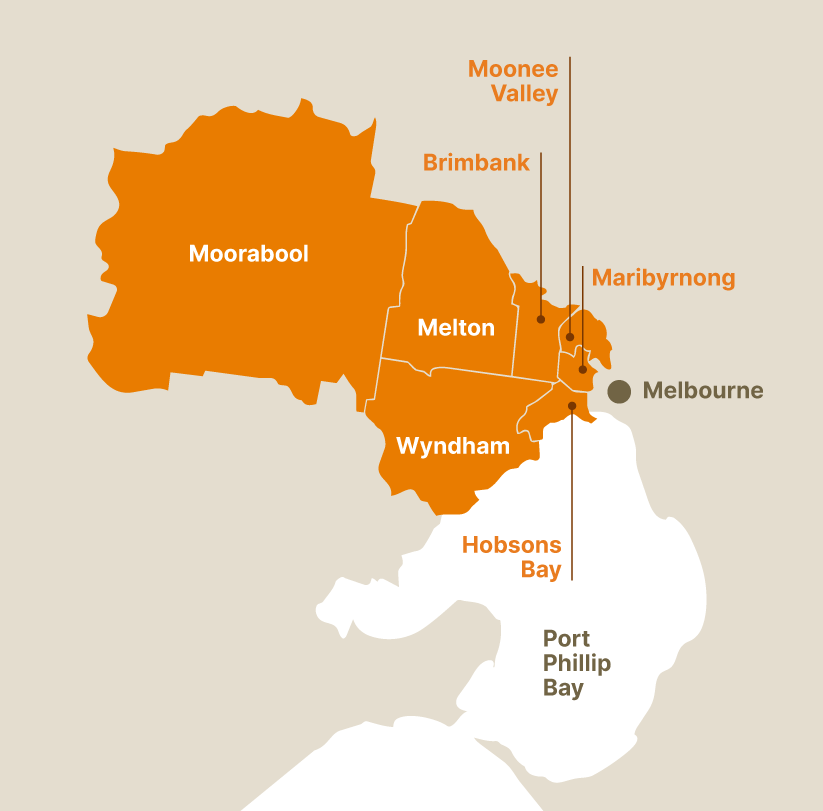
WAGA’s member councils work collaboratively to respond to climate change across the region and encourage their communities, residents and businesses to make a transition to a low carbon society.
Brimbank City Council
Brimbank City Council declared a climate emergency in 2019 and is committed to creating a resilient, safe and sustainable environment for all Brimbank residents. Addressing the health impacts of climate change is a key priority in Brimbank’s health and wellbeing plan. Brimbank’s priorities include:
Decarbonising Council operations to achieve net zero by 2040
Adapting our places to be safe, accessible and resilient to extreme weather
Supporting the community to manage extreme weather
Protecting biodiversity and increasing canopy cover
Managing climate risks responsibly in line with legislation.
Maribyrnong City Council recognises that the global climate emergency affects everyone. It poses a threat to society, the economy, and the environment. This requires a different approach, grounded in risk awareness, adaptation, and mitigation.
To deliver this, our key priority areas are:
Reducing council greenhouse emissions – Minimising operational emissions across all council activities.
Supporting community action – Helping community reduce their environmental impact and cut emissions.
Improving building efficiency – Upgrading council facilities to use less energy and operate more sustainably.
Strengthening climate resilience – Ensuring our community is prepared for and protected from climate impacts.
Creating greener, cooler public spaces – Designing healthier, more comfortable outdoor environments.
Protecting and restoring nature – Conserving biodiversity and enhancing natural ecosystems.
Improving water stewardship – Conserving water and improving stormwater quality.
Reducing air pollution – Cutting harmful pollutants to support community health.
Supporting low and zero‑emission transport – Encouraging cleaner, more sustainable mobility options.
Reducing waste to landfill – Being conscientious about consumption and minimising the amount of waste sent to landfill.
Moorabool Shire recognises the challenges faced by a changing climate and fast-growing population. They are committed to protecting and enhancing the natural environment while championing sustainable practices across their operations and with the local community in collaboration with agency partners.
The City of Melton is growing at one of the fastest rates in Australia, with the population set to almost double in the same time frame Council aims to meet its target of net-zero emissions. Melton faces the challenge of securing an environment that will be safe and resilient for future generations.
Key priority areas:
A City that plans for and adapts to climate change.
A City that builds collaborative partnerships to facilitate collective action to address climate change and its impacts on health.
A City that is clean, minimises waste and increases resource recovery through efficient, sustainable practices.
A greener City that protects and enhances its natural environment
Moonee Valley City Council acknowledged a climate emergency in 2019. MV2040, Council’s community vision and strategy outlines the following ‘Green’ strategic directions:
To nurture a green future, through caring for Country and creating a clean, sustainable, climate-safe city for future generations.
To champion our environment by supporting healthy, resilient ecosystems and expanding our green spaces, natural waterways and urban canopy.
Green strategic objectives:
A city that is zero carbon.
A city that is climate-safe.
A city that has increased biodiversity, shade and is water-sensitive
A city that repurposes and recycles to minimise waste
Wyndham City Council is characterised by rapid urban development and high multiculturalism. We are committed to nurturing our land and environment for future generations. We acknowledge that creating a climate change resilient city, will require coordinated, place-based action, strong partnerships across all levels of government, and meaningful engagement with the community, particularly those most vulnerable to climate impacts.
Strategic adaptation priorities:
A Cooler Greener City
Supporting Community Climate Change Adaptation
Embedding Climate Change Action Across Council
Reducing Council’s Greenhouse Gas Emissions
Supporting Community Greenhouse Gas Emission Reduction
The Western Alliance for Greenhouse Action (WAGA) respectfully acknowledges and recognises the Woiwurrung, Bunurong, Wadawurrung and Dja Dja Wurrung people of the Kulin Nation as the Traditional Custodians of the land on which we work and we pay respect to their Elders, past, present and future.